 Built for Canada, Made in Canada. 100% Canadian-owned & operated.
  EN
EN  FR
FR  US
US  ES
ES 


When it comes to reducing carbon in buildings, the conversation usually starts with operational energy. That’s important. But a large share of a building’s carbon footprint is already in place before the lights turn on.
That’s embodied carbon. It includes emissions related to material extraction, manufacturing, transportation, installation, and end-of-life impacts. Once construction is complete, those emissions are built in for the life of the building.
As designers, builders, and owners look for ways to reduce environmental impact, insulation choices play a meaningful role. Recent research from RDH Building Science and Toronto Metropolitan University helps clarify how higher-performance insulation systems can support lower embodied carbon at the enclosure level.
For a deeper look at embodied carbon and how spray foam insulation fits into low-carbon design, visit our Low Carbon Spray Foam Insulation page.
What is embodied carbon in buildings?
Embodied carbon refers to the greenhouse gas emissions associated with building materials before and during construction. This includes everything from raw material extraction to disposal or recycling at end of life. Unlike operational energy, embodied carbon cannot be improved later. The decisions are made at the start.
What the RDH and TMU research shows
The RDH × TMU study examined the embodied carbon impact of common insulation types within complete wall assemblies designed to meet the same thermal performance targets. The focus was not on individual products in isolation, but on how entire assemblies perform in real buildings.

Embodied carbon of common insulation types vs insulation thickness
Source: RDH Embodied Carbon – Elastochem / Honeywell Enclosures 2025
One key takeaway was straightforward. Materials that deliver more thermal performance per inch tend to require less material overall, which can reduce embodied carbon. Closed-cell spray polyurethane foam was included in the analysis as a high-efficiency option.
In a comparative study, two retrofit wall assemblies designed to achieve an effective R-24. The spray foam assembly showed approximately 40% embodied carbon than a mineral wool assembly. Both met the same performance requirement. The difference was how efficiently they got there.
Why higher R-value per inch matters
Higher R-value per inch reduces the amount of material needed to achieve the same level of performance, helping minimize deliveries and on-site waste.
Closed-cell spray foam is manufactured on site from liquid components. In practical terms, one truckload of spray foam can replace roughly five truckloads of board stock insulation. That means fewer trucks, less fuel used, and less material wasted. Learn more about how transportation impacts embodied carbon.
Fewer layers, lower carbon impact
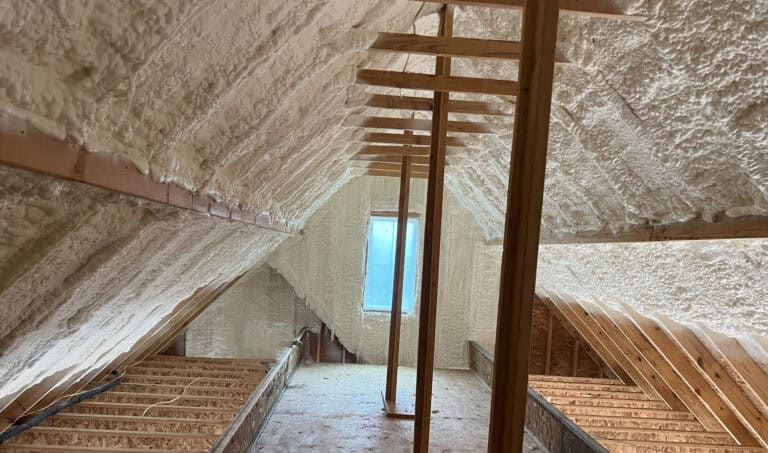
Closed-cell spray foam provides thermal insulation, air control, and vapour control in a single application. When fewer materials and layers are needed to meet enclosure performance targets, embodied carbon at the system level is reduced.
This is why embodied carbon assessments work best when they consider the full assembly. Performance requirements, supporting layers, transportation needs and material quantities all matter.
Lower carbon starts at the enclosure
Lowering embodied carbon starts at the early stages with design and material selection. Choosing high-performance, integrated insulation systems can reduce material use, simplify assemblies, and lower environmental impact from day one.
To explore the RDH × TMU research, compare insulation assemblies, and see how closed-cell spray foam supports low-carbon enclosure design, visit our Low Carbon Spray Foam Insulation page.